About Rio Shutia and El Salvador
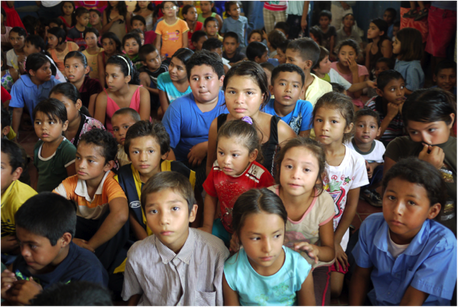
Poverty levels in rural areas of El Salvador can be as high as 62%. Many of these families live on less than a US $1 per day and cannot afford daily food. The education situation is not very promising. According to the Salvadoran government statistics in 2004, only 5% of the population had a university-level degree. In El Salvador, a person who does not have a professional career cannot expect a good salary; people who have no secondary education must work for less than the minimum salary of $80 every fifteen days.
The typical school year in El Salvador runs from January through November. While education is compulsory from ages 7 through 12, a large number of children cannot attend school either because they need to support their families, or because of a lack of interest in learning and a keen attraction to joining gangs.
The Centro Escolar Shutia is located at La Libertad, one of El Salvador’s 14 departments. It is a school to 226 children of low resources and teaches grades 0-6. The curriculum at Centro Escolar Shutia is composed of basic courses: mathematics, literature, writing, science, history, social studies, and art. Like all schools located in underdeveloped communities in El Salvador, Escolar Shutia has problems with attendance and poor graduation rates. Many of these children leave school to find work, but their lack of education limits their earning potential and thus reinforces the cyclical trap of poverty. This school needs the facilities to teach fundamental wellness practices and inspire a stronger learning community inside each classroom.
The typical school year in El Salvador runs from January through November. While education is compulsory from ages 7 through 12, a large number of children cannot attend school either because they need to support their families, or because of a lack of interest in learning and a keen attraction to joining gangs.
The Centro Escolar Shutia is located at La Libertad, one of El Salvador’s 14 departments. It is a school to 226 children of low resources and teaches grades 0-6. The curriculum at Centro Escolar Shutia is composed of basic courses: mathematics, literature, writing, science, history, social studies, and art. Like all schools located in underdeveloped communities in El Salvador, Escolar Shutia has problems with attendance and poor graduation rates. Many of these children leave school to find work, but their lack of education limits their earning potential and thus reinforces the cyclical trap of poverty. This school needs the facilities to teach fundamental wellness practices and inspire a stronger learning community inside each classroom.
